The global pharmaceutical industry is undergoing a major transformation. Pharmaceutical companies are increasingly looking for specialised partners who can support drug research, product development and large-scale manufacturing.
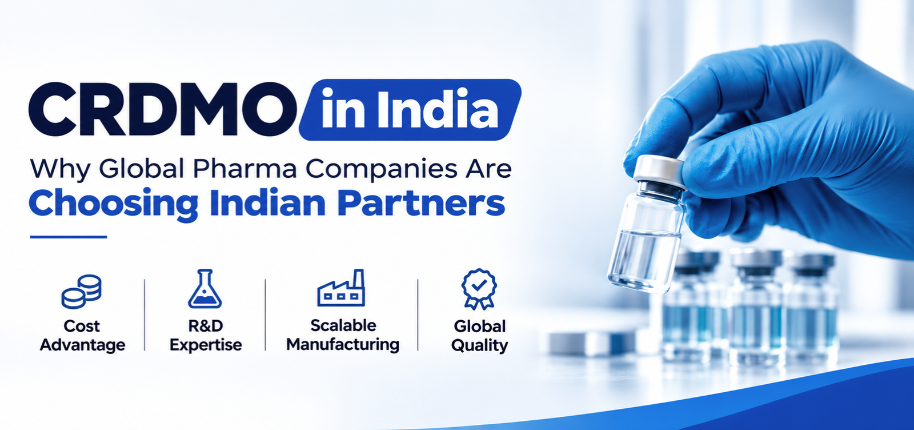
This shift has brought the CRDMO industry in India into greater focus. With established pharmaceutical manufacturing capabilities, a skilled scientific workforce and growing research infrastructure, India is becoming an important destination for global pharmaceutical outsourcing.
As companies explore new ways to improve operational efficiency, diversify supply chains and develop complex medicines, Indian Contract Research, Development and Manufacturing Organisations (CRDMOs) are gaining attention.
But what exactly makes India an attractive CRDMO destination? And what opportunities does this growing sector create for the Indian pharmaceutical industry?
Let's explore.
Table of Contents
What Is CRDMO in the Pharmaceutical Industry?
CRO vs CDMO vs CRDMO: Understanding the Difference
Why Are Global Pharma Companies Choosing India?
How the China+1 Strategy Is Creating Opportunities
Key Technologies Transforming the CRDMO Industry
Emerging Opportunities in India's CRDMO Sector
Challenges Facing the Indian CRDMO Industry
What Does CRDMO Growth Mean for India's Pharma Industry?
Frequently Asked Questions
1. What Is CRDMO in the Pharmaceutical Industry?
CRDMO stands for Contract Research, Development and Manufacturing Organisation.
A CRDMO is a specialised service provider that supports pharmaceutical and biotechnology companies at different stages of the drug development process.
Instead of managing every activity internally, pharmaceutical companies can partner with a CRDMO for specialised research, development and manufacturing services.
These services may include:
Drug discovery and early-stage research
Preclinical research support
Formulation and process development
Analytical testing and development
Active Pharmaceutical Ingredient (API) development
Clinical development support
Commercial-scale manufacturing
The integrated service model allows pharmaceutical companies to work with specialised partners across multiple stages of product development.
This can help companies access technical expertise, specialised infrastructure and manufacturing capabilities without building every facility or team themselves.
2. CRO vs CDMO vs CRDMO: Understanding the Difference
These terms are often used in the pharmaceutical outsourcing industry, but they refer to different service models.
| Business model | Main focus |
|---|---|
| CRO | Contract Research Organisation – provides research-related services |
| CDMO | Contract Development and Manufacturing Organisation – supports product development and manufacturing |
| CRDMO | Combines research, development and manufacturing services |
A CRO primarily supports research activities, while a CDMO focuses on developing and manufacturing pharmaceutical products.
A CRDMO brings these capabilities together under a broader service model.
For global pharmaceutical companies, this integrated approach can simplify coordination between different stages of product development.
3. Why Are Global Pharma Companies Choosing India?
India has developed a strong position in the global pharmaceutical industry. Its manufacturing experience, technical workforce and expanding research capabilities are contributing to the growth of its contract research and manufacturing ecosystem.
Here are some important factors attracting global pharmaceutical companies.
A. Established Pharmaceutical Manufacturing Base
India has a well-developed pharmaceutical manufacturing ecosystem, including capabilities in generic medicines, APIs and pharmaceutical formulations.
This industrial experience provides a foundation for companies looking to expand their contract development and manufacturing operations.
B. Skilled Scientific and Technical Workforce
Research and development require trained scientists, chemists, pharmacists, engineers and other technical professionals.
India's pharmaceutical and life sciences education ecosystem supports the availability of skilled professionals across research, development, quality and manufacturing functions.
C. Cost-Efficient Operations
Research and manufacturing costs are important considerations for global pharmaceutical companies.
India can offer cost advantages in several operational areas. However, cost is only one factor when companies evaluate a CRDMO partner. Technical capabilities, quality systems, regulatory compliance and project execution are equally important.
D. Growing Research and Development Capabilities
The Indian pharmaceutical sector is gradually expanding beyond traditional manufacturing activities.
Investment in research infrastructure, specialised facilities and advanced technologies is creating opportunities in complex pharmaceutical development and manufacturing.
E. Access to Global Markets
Indian pharmaceutical businesses have experience serving international markets and working within different regulatory environments.
This experience can support the development of long-term relationships with international pharmaceutical companies.
4. How the China+1 Strategy Is Creating Opportunities for Indian CRDMOs
The China+1 strategy refers to an approach in which companies diversify their manufacturing and sourcing operations by adding alternative locations alongside their existing facilities.
For pharmaceutical companies, supply-chain diversification has become an important business consideration.
Rather than depending heavily on a single country or manufacturing location, companies may explore additional partners to improve supply-chain flexibility and reduce concentration risks.
India is one of the destinations being considered because of its pharmaceutical manufacturing base, scientific talent and expanding contract development capabilities.
This creates opportunities for Indian CRDMOs to work with global pharmaceutical companies seeking:
Additional manufacturing locations
Research and development partners
API and intermediate manufacturing capabilities
Specialised product development
Long-term contract manufacturing relationships
However, attracting global partnerships requires more than competitive pricing. Companies must also demonstrate consistent quality, technical expertise, regulatory readiness and dependable project execution.
5. Key Technologies Transforming the CRDMO Industry
Technology is changing how pharmaceutical research, product development and manufacturing are carried out.
Indian CRDMOs are exploring new tools and processes to improve efficiency, strengthen quality systems and support increasingly complex pharmaceutical projects.
Artificial Intelligence in Drug Discovery
Artificial Intelligence (AI) can help researchers analyse large datasets, identify potential drug candidates and support early-stage research.
It is also being explored for research planning, data analysis and other drug development activities.
Automation in Pharmaceutical Manufacturing
Automation can support production consistency, process monitoring and operational efficiency.
It can also reduce dependence on certain repetitive manual activities when implemented with appropriate quality controls.
Digital Manufacturing Systems
Digital systems can help organisations monitor manufacturing activities, maintain production records and improve visibility across operational processes.
Advanced Analytical Technologies
Analytical testing plays an important role in pharmaceutical development.
Advanced analytical techniques can support the evaluation of product characteristics, quality attributes and manufacturing processes.
The adoption of these technologies can help CRDMOs strengthen their capabilities and meet the evolving requirements of global pharmaceutical clients.
6. Emerging Opportunities in India's CRDMO Sector
The CRDMO industry is expanding towards specialised products and more complex manufacturing requirements.
Some important areas include:
Biologics and Biosimilars
Biologics are medicines developed using living cells or biological systems. Biosimilars are highly similar versions of approved biological medicines.
Both areas require specialised research, development and manufacturing capabilities.
Peptide Manufacturing
Peptides are short chains of amino acids with applications across different therapeutic areas.
Growing interest in peptide-based medicines is creating opportunities for specialised development and manufacturing services.
Antibody-Drug Conjugates (ADCs)
Antibody-Drug Conjugates combine antibodies with drug components to deliver targeted treatment approaches.
Their development involves specialised scientific and manufacturing processes.
Complex APIs
Active Pharmaceutical Ingredients are the substances responsible for the therapeutic action of medicines.
Developing and manufacturing complex APIs may require advanced chemistry, specialised equipment and strong quality systems.
Sterile Injectables
Sterile injectable products require controlled manufacturing environments, specialised infrastructure and strict quality procedures.
These areas represent opportunities for Indian CRDMOs to develop capabilities in more specialised segments of the pharmaceutical industry.
7. Challenges Facing the Indian CRDMO Industry
Although India has significant opportunities in the CRDMO sector, continued growth will depend on addressing several challenges.
Regulatory compliance: Global pharmaceutical projects require adherence to applicable regulatory requirements and quality standards.
Advanced infrastructure: Complex products may require specialised facilities, equipment and manufacturing environments.
Technology investment: Companies need to keep pace with developments in research, automation and digital manufacturing.
Skilled talent: Advanced therapies and complex molecules require specialised technical knowledge and experienced professionals.
Global competition: Indian CRDMOs compete with service providers in other established pharmaceutical and biotechnology markets.
Project execution: Maintaining product quality, timelines and consistent communication is essential for long-term international partnerships.
Addressing these challenges will help Indian organisations strengthen their position in the global pharmaceutical outsourcing market.
8. What Does CRDMO Growth Mean for India's Pharmaceutical Industry?
The expansion of the CRDMO industry can create opportunities across India's wider pharmaceutical and life sciences ecosystem.
Some potential areas of impact include:
Greater investment in pharmaceutical research and development
Increased demand for specialised scientific professionals
Development of advanced manufacturing infrastructure
Opportunities for technology and laboratory service providers
Stronger participation in global pharmaceutical value chains
Greater collaboration between Indian and international companies
For India, the opportunity is to build on its existing pharmaceutical manufacturing strengths while developing greater capabilities in research, innovation and complex product development.
Agrosaf Pharmaceuticals: Understanding India's Evolving Pharma Landscape
India's pharmaceutical industry includes a wide network of manufacturers, suppliers, distributors, wholesalers and healthcare businesses.
As the industry evolves, staying informed about emerging pharmaceutical segments and market developments becomes important for businesses across the sector.
Agrosaf Pharmaceuticals offers a diverse pharmaceutical product portfolio for B2B sourcing requirements. Its B2B platform allows pharmacies, distributors and other healthcare businesses to explore available products and access relevant product information.
Explore the Agrosaf B2B platform to learn more about its pharmaceutical portfolio.
Frequently Asked Questions (FAQs)
1. What is CRDMO in pharma?
CRDMO stands for Contract Research, Development and Manufacturing Organisation. It provides specialised services across different stages of pharmaceutical research, product development and manufacturing.
2. Why is India becoming an important CRDMO destination?
India offers an established pharmaceutical manufacturing base, skilled scientific professionals, research capabilities and cost-efficient operations. These factors make it an important destination for global pharmaceutical outsourcing.
3. What is the difference between CRO, CDMO and CRDMO?
A CRO focuses mainly on contract research services. A CDMO provides product development and manufacturing services, while a CRDMO combines research, development and manufacturing capabilities.
4. What is the China+1 strategy in the pharmaceutical industry?
The China+1 strategy involves diversifying manufacturing and sourcing operations by adding alternative countries alongside existing locations. India is one of the countries being considered for pharmaceutical supply-chain diversification.
5. Which technologies are transforming the CRDMO industry?
Artificial Intelligence, automation, digital manufacturing systems and advanced analytical technologies are influencing pharmaceutical research, development and manufacturing.
6. What are the emerging opportunities in India's CRDMO sector?
Emerging opportunities include biologics, biosimilars, peptides, complex APIs, antibody-drug conjugates and sterile injectable manufacturing.
7. Is CRDMO the same as contract manufacturing?
No. Contract manufacturing generally focuses on producing products for another company. CRDMO services can cover a wider range of activities, including research, development and manufacturing.
Conclusion
The CRDMO industry in India is gaining importance as global pharmaceutical companies look for specialised research, development and manufacturing partners.
India's established pharmaceutical ecosystem, scientific workforce, expanding research capabilities and manufacturing experience provide a strong foundation for future growth.
However, long-term success will depend on continuous investment in technology, advanced infrastructure, quality systems and regulatory compliance.
As global pharmaceutical outsourcing continues to evolve, Indian CRDMOs have an opportunity to strengthen international partnerships and contribute to the next phase of pharmaceutical innovation.
Conclusion / Notes
- India is emerging as an important destination for global CRDMO partnerships. - Skilled scientific talent and manufacturing capabilities support industry growth. - The China+1 strategy is creating opportunities for pharmaceutical outsourcing. - AI, automation and advanced technologies are transforming drug development. - Biologics, peptides and complex APIs are opening new opportunities for Indian CRDMOs.
0 Comments
Recent Posts