Launching a healthcare brand in an international market can be challenging when businesses have to manage product selection, formulation, packaging, documentation, quality requirements, and supply coordination on their own. Private labeling can simplify this process by allowing a buyer to develop products under their own brand while working with an experienced healthcare supply partner.
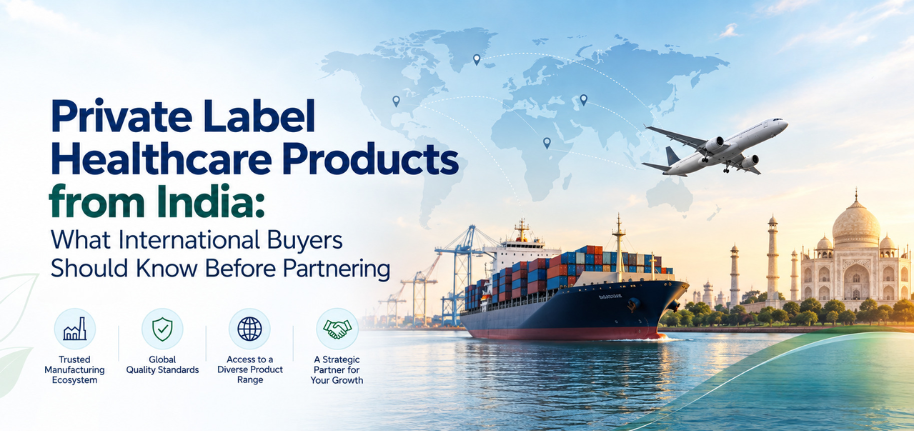
India has an established pharmaceutical and healthcare-products ecosystem, but international buyers should not choose a private-label partner based on product catalogue or price alone. Regulatory requirements, documentation, quality systems, product suitability, packaging, and supply capabilities all need to be evaluated before entering a long-term partnership.
Here are the key things international buyers should know before partnering for private-label healthcare products from India.
What Is Private Label Healthcare?
Private label means a product is supplied for sale under the buyer's own brand name rather than the supplier's consumer-facing brand.
Depending on the product category and market, private-label programs may involve:
- Product or formulation selection
- Brand and packaging customization
- Label development
- Product documentation
- Quality and testing requirements
- Batch production through a qualified manufacturing facility
- Export documentation
- Bulk supply and repeat orders
The exact process depends on the product category, destination country, and applicable regulations.
For pharmaceuticals in particular, regulatory requirements can be significantly different from those for nutraceuticals, cosmetics, or OTC products. International buyers should therefore identify the product's regulatory classification in their target market before finalizing a product.
1. Start With the Destination Market
One of the biggest mistakes buyers can make is selecting a product first and checking regulations later.
A product that can be marketed as a supplement in one country may be regulated differently in another. Similarly, pharmaceutical products may require registration, market authorization, specific documentation, or local regulatory representation.
Before selecting products, buyers should clarify:
- Target country
- Product category
- Intended claims
- Dosage form
- Ingredients and strengths
- Required registrations
- Labelling requirements
- Import requirements
- Shelf-life expectations
For exported drugs from India, CDSCO guidance states that export labels need to meet the requirements of the destination country's law, while specified information such as product name, manufacturer details, batch/lot number and expiry requirements may also apply.
2. Check the Quality and Manufacturing Setup
A private-label partner should be able to clearly explain where and how the product will be manufactured.
International buyers should ask for relevant information about:
- Manufacturing facility
- Applicable GMP compliance
- Quality-control procedures
- Testing laboratories
- Batch documentation
- Stability data, where applicable
- Certificates required for the target market
- Previous export experience
The documentation required can vary considerably depending on whether the product is a pharmaceutical, nutraceutical, cosmetic, Ayurvedic product, or another healthcare category.
For pharmaceutical exports, international regulatory expectations may also involve specific certificates and facility-related documentation.
3. Don't Choose a Supplier Only on MOQ or Price
Low MOQ and competitive pricing can be attractive, especially for a new healthcare brand.
But the lowest quotation does not necessarily represent the lowest overall business cost.
Buyers should also evaluate:
Product quality + documentation + packaging + regulatory support + lead time + communication + supply consistency
A slightly different commercial offer may make more sense if it provides better documentation, reliable batch supply, suitable packaging, and smoother export coordination.
4. Understand What Can Be Customized
Before signing an agreement, ask exactly what the private-label partner can customize.
Depending on the product and market, customization may include:
- Brand name
- Packaging design
- Label information
- Pack size
- Product format
- Flavour or variant
- Carton configuration
- Marketing/product information
However, not every customization is possible for every product. Regulatory and manufacturing requirements can limit changes.
This is why buyers should discuss customization before artwork and packaging are finalized.
5. Review Product Documentation Carefully
Documentation is one of the most important parts of international healthcare sourcing.
Depending on the product, buyers may need documents such as:
- Product specification
- Certificate of Analysis (CoA)
- Batch-related documents
- Manufacturing licence or relevant facility documentation
- GMP-related certificates
- Free Sale Certificate, where applicable
- Product composition
- Stability information
- Export documents
- Packaging and labelling information
For certain export applications, CDSCO guidance specifies product details such as dosage form, composition, strength, pack size, quantity and destination country as part of the documentation submitted for export-related approvals.
The buyer should confirm the exact document list with the relevant authority or regulatory consultant for the destination market.
6. Pay Close Attention to Packaging and Labelling
Packaging is not only about making a product look premium.
For international markets, labels may need to comply with destination-country requirements regarding information, language, claims, warnings, manufacturer details, batch information, expiry, storage instructions and other declarations.
Before printing large quantities, buyers should have the final artwork reviewed against the applicable market requirements.
A packaging mistake can create unnecessary rework, delays, or additional costs.
7. Ask About Lead Times and Repeat Supply
A private-label partnership should work beyond the first shipment.
Before placing an initial order, discuss:
- Sample development timeline
- Artwork approval timeline
- Production lead time
- Minimum order quantity
- Shipping timeline
- Reorder process
- Expected production capacity
- Raw-material availability
- Communication during delays
This becomes particularly important once the buyer's brand starts generating regular demand.
8. Evaluate Communication and Transparency
International sourcing involves multiple stages. A buyer may need information from product development through packaging, documentation, production and shipment.
A suitable partner should communicate clearly about:
- Product availability
- Pricing
- MOQ
- Timelines
- Documentation
- Quality checks
- Packaging requirements
- Shipment status
Clear communication can prevent small issues from becoming expensive delays.
9. Think Beyond the First Order
A private-label healthcare partnership should ideally be evaluated as a long-term supply relationship rather than a one-time transaction.
Before partnering, ask:
Can this supplier support my brand when my order volume grows?
Look at product range, category expertise, documentation capabilities, supply planning, export experience and ability to coordinate multiple products.
Exploring Healthcare Sourcing From India With Agrosaf
For international buyers looking to source healthcare products from India, Agrosaf Pharmaceuticals offers a broad portfolio across pharmaceutical, Ayurvedic, OTC, nutraceutical, cosmetic and other healthcare categories. Our Export Division works with international buyers on product sourcing, documentation, regulatory requirements and cross-border supply based on market needs.
Buyers can explore our healthcare product portfolio and connect with the export team to discuss product availability, requirements and international supply opportunities.
Explore Agrosaf's B2B Healthcare Product Portfolio
FAQs
Is private labeling available for pharmaceutical products?
Private-label arrangements may be possible depending on the product, regulatory classification, destination market and applicable approvals. Buyers should confirm the requirements before proceeding.
Can international buyers customize packaging?
Packaging and labelling can often be customized, but the permitted changes depend on the product and destination-country requirements.
What should international buyers check before placing an order?
Buyers should evaluate product quality, documentation, regulatory requirements, MOQ, pricing, packaging, lead time, supply reliability and communication.
Is India suitable for private-label healthcare sourcing?
India has an established pharmaceutical and healthcare-products ecosystem, but buyers should evaluate each supplier and manufacturing arrangement individually rather than relying only on the country of origin.
Conclusion
Private-label healthcare sourcing from India can give international businesses an opportunity to build their own brands without developing every product from the ground up. However, successful sourcing depends on much more than product selection and price.
Before partnering, international buyers should verify regulatory requirements, product quality, documentation, packaging, customization options, lead times and long-term supply capabilities. A well-evaluated partnership can make the process of developing and supplying a healthcare brand more structured and manageable across international markets
Conclusion / Notes
Private-label healthcare sourcing from India involves more than product selection and pricing. International buyers should evaluate regulatory requirements, product quality, documentation, packaging, customization, lead times, and long-term supply capabilities before choosing a partner.
0 Comments
Recent Posts