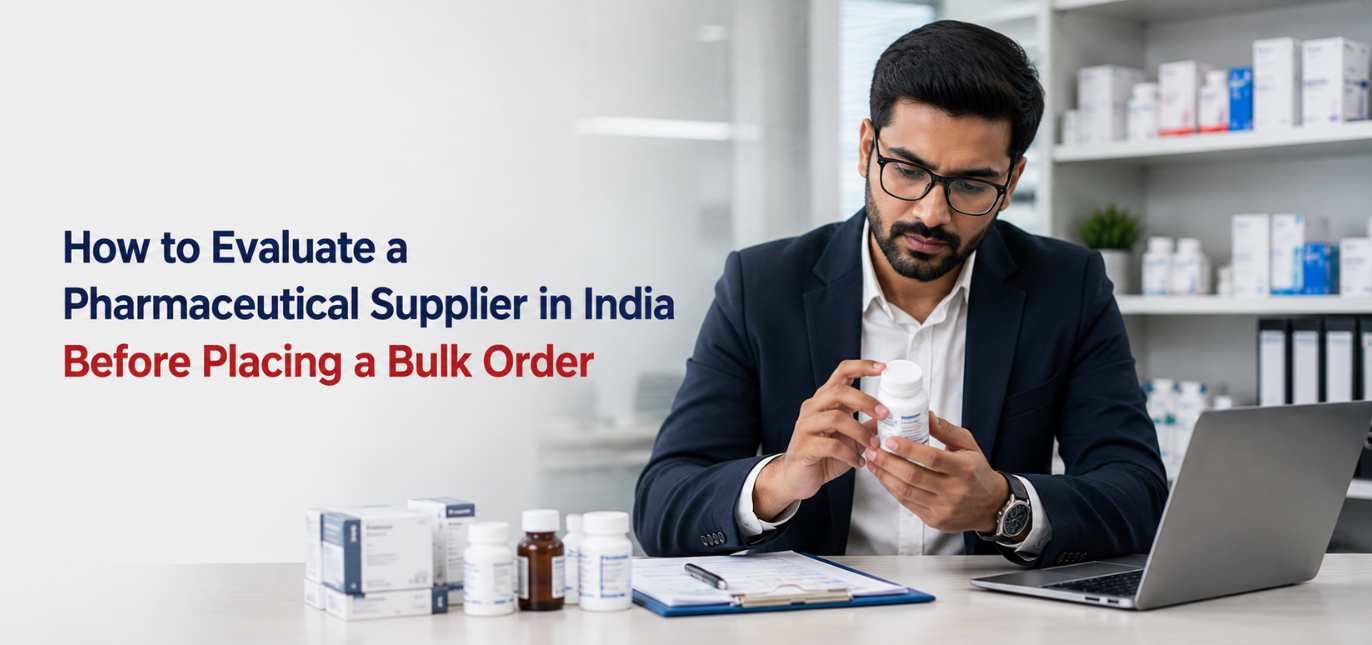
Choosing a pharmaceutical supplier for a bulk order is not simply a matter of comparing quotations.
For pharma distributors, healthcare businesses, institutional buyers, exporters and pharmaceutical brand owners, the wrong supplier can create problems far beyond an initial purchasing decision—from inconsistent product quality and documentation gaps to delayed deliveries, regulatory complications and supply disruptions.
A reliable pharmaceutical supplier should therefore be evaluated across regulatory compliance, product quality, manufacturing capability, documentation, supply reliability and commercial terms.
India's pharmaceutical sector operates under a regulatory framework that includes the Drugs and Cosmetics Act, 1940 and Drugs Rules, 1945, while manufacturing quality requirements include Good Manufacturing Practices (GMP) under Schedule M. CDSCO maintains the current Drugs Rules and related regulatory notifications.
So, before placing a large pharmaceutical order, what exactly should a buyer check?
1. Verify the Supplier's Regulatory and Licensing Status
The first step is to establish whether the supplier is legally authorized to manufacture, market, distribute or supply the pharmaceutical products you intend to purchase.
Do not rely only on a company's website or sales presentation. Ask for the relevant regulatory and business documentation and verify that it corresponds to the actual entity and manufacturing facility involved in your order.
Depending on the product and business arrangement, buyers may need to review:
Applicable drug manufacturing or sale licences
Manufacturing-site details
Product details covered by the applicable licence
Company registration and business information
GST and other commercial documentation
Product registration or approval information where applicable
The exact requirements can differ depending on the product category and whether you are dealing with a manufacturer, marketer, distributor or exporter.
The key question is not simply, "Is this company registered?"
It is:
"Is this supplier appropriately authorized to supply the specific pharmaceutical product I am purchasing?"
This distinction becomes particularly important when placing high-volume or repeat orders.
2. Check GMP and the Manufacturing Quality System
A pharmaceutical supplier's quality system should be one of your highest-priority evaluation criteria.
Schedule M of India's Drugs Rules establishes Good Manufacturing Practices and requirements for pharmaceutical premises, plant and equipment. CDSCO's regulatory framework includes specific GMP requirements for pharmaceutical manufacturing.
However, buyers should look beyond a certificate or a logo on a website.
Ask questions such as:
What quality-management system does the manufacturing facility follow?
Is the manufacturing site appropriately licensed?
How are raw materials controlled and tested?
How are manufacturing deviations investigated?
How are complaints handled?
What systems are used for batch traceability?
How are quality issues and potential recalls managed?
A genuine quality-focused supplier should be able to explain its quality processes clearly rather than simply saying that it is "GMP certified."
3. Evaluate the Specific Product, Not Just the Company
One of the most common mistakes in supplier evaluation is assessing the company but not the individual product.
A supplier may have an established manufacturing facility, but that does not eliminate the need to evaluate the particular medicine, dosage form, strength, specifications and manufacturing site involved in your order.
For every bulk pharmaceutical product, consider reviewing:
Product name
Active ingredient and strength
Dosage form
Product specifications
Manufacturing site
Batch information
Shelf life
Storage conditions
Packaging configuration
Applicable testing and quality documentation
Product registration or approval status where relevant
WHO procurement guidance similarly emphasizes product-specific qualification and recommends checking that the product being purchased corresponds to the qualified product and manufacturing site.
This is especially important when a supplier operates multiple manufacturing facilities or sources products through third parties.
4. Ask for Relevant Quality and Regulatory Documents
Before finalizing a large order, request the documentation that is relevant to the product and your procurement requirements.
Depending on the product and transaction, this may include:
Certificate of Analysis (COA)
Product specifications
Batch-related documentation
Manufacturing licence
GMP-related documentation
Stability or shelf-life information where applicable
Packaging specifications
Product registration or approval documents where applicable
Quality-control documentation
Do not assume that every pharmaceutical product or transaction requires exactly the same documents.
Instead, ask the supplier:
"Which quality and regulatory documents apply to this product, and can you provide them before order confirmation?"
A supplier that is transparent about documentation is generally easier to qualify and manage over the long term.
5. Evaluate Manufacturing Capacity Before Placing a Bulk Order
A supplier may have a good product and competitive pricing but still be unsuitable for your business if it cannot consistently fulfil your required volumes.
This becomes particularly important for:
Large institutional orders
Pharma distributors
Exporters
PCD businesses
Private-label brands
Repeat monthly procurement
Ask the supplier:
What is the minimum order quantity?
What is the normal production lead time?
What is the available production capacity?
Can the supplier support repeat orders?
How quickly can production be scaled if demand increases?
Is the product manufactured in-house or through a third-party facility?
What happens if production is delayed?
WHO guidance for pharmaceutical procurement specifically recommends evaluating a supplier's ability to supply the required quantities, along with other qualification criteria.
For a bulk buyer, capacity is part of quality because inconsistent supply can ultimately affect your own customers and operations.
6. Compare Quality, Not Just the Quotation
The lowest quotation is not automatically the best deal.
A cheaper supplier can become more expensive if you later encounter:
Delayed deliveries
Documentation problems
Product rejection
Packaging defects
Short remaining shelf life
Inconsistent batch quality
Replacement delays
Unreliable repeat supply
WHO procurement guidance explicitly states that pharmaceutical procurement should not focus on price alone and should prioritize quality-assured products and sustained supply.
A better comparison considers:
Product quality + regulatory compliance + supply reliability + documentation + lead time + commercial terms + total procurement cost
This gives buyers a more realistic picture of supplier value.
7. Check Batch Testing and Traceability
For pharmaceutical procurement, traceability matters.
Ask how the supplier identifies and tracks individual batches from manufacturing through release and supply.
Depending on the product, buyers may want to understand:
Batch numbering
Testing procedures
Quality-control release
COA availability
Manufacturing records
Expiry and shelf-life controls
Complaint handling
Product recall procedures
The goal is not to demand unnecessary documentation. It is to ensure that if a quality or supply issue occurs, the product can be traced and the supplier has a defined process for addressing it.
8. Evaluate Shelf Life and Storage Requirements
A bulk order can represent a significant investment. Receiving a product with insufficient remaining shelf life can create an avoidable commercial problem.
Before ordering, clarify:
Manufacturing date
Expiry date
Expected remaining shelf life at delivery
Recommended storage conditions
Packaging requirements
Transportation conditions where applicable
For products with specific storage requirements, ask how those conditions are maintained during transportation and distribution.
This is particularly important for buyers who will hold inventory for extended periods.
9. Assess Packaging and Labelling Requirements
Packaging is not merely a design consideration in pharmaceutical procurement.
It can affect product protection, storage, transportation, identification and regulatory compliance.
Confirm:
Primary packaging
Secondary packaging
Pack size
Batch and expiry information
Labelling requirements
Shipping configuration
Carton specifications
Destination-market requirements for exports
If you are purchasing under your own brand or private-label arrangement, discuss artwork, specifications, approval processes and production timelines before confirming the order.
For exports, additional requirements may apply depending on the destination country.
10. Review Lead Times and Supply Reliability
A supplier that delivers one successful order is not necessarily a reliable long-term partner.
For recurring pharmaceutical procurement, examine the supplier's ability to maintain consistent supply.
Ask about:
Standard lead time
Production scheduling
Dispatch timelines
Order confirmation process
Communication during delays
Emergency or urgent requirements
Repeat-order planning
Inventory availability
It is also useful to understand what happens when demand changes unexpectedly.
A dependable supplier should be able to communicate early when a supply issue could affect your order.
11. Evaluate Commercial Terms Carefully
Once quality and regulatory requirements are satisfied, compare the commercial terms.
Look beyond the unit price.
Review:
MOQ
Payment terms
Credit terms, if applicable
Freight and transportation costs
Packaging charges
Taxes
Lead time
Replacement policy
Damaged-goods policy
Order cancellation terms
Price validity
Conditions for repeat orders
The objective is to understand your actual landed procurement cost, not just the number shown on the initial quotation.
12. Assess the Supplier's Communication and Professionalism
Communication is often overlooked during supplier selection.
But once you begin placing large or recurring orders, communication becomes part of the supply chain.
Pay attention to:
How quickly enquiries are answered
Whether technical questions receive clear answers
Whether documents are shared promptly
Whether quotations are detailed
Whether timelines are realistic
Whether changes are communicated proactively
Whether the sales and quality teams coordinate effectively
A supplier who is difficult to communicate with before receiving an order may become even more difficult to manage when there is a production or quality issue.
13. Check the Supplier's Track Record
Before committing to a significant order, research the supplier's business history and market presence.
Look for evidence of:
Relevant pharmaceutical experience
Manufacturing capabilities
Product portfolio
Domestic or international supply experience
Long-term B2B relationships
Quality and regulatory capabilities
Consistency in communication and fulfilment
For international procurement, additional qualification may be required depending on the destination market and product.
WHO's supplier-qualification approach also considers factors such as financial standing, supply capacity and product registration status.
14. Consider Starting With a Controlled Order
If you are working with a new supplier, placing the largest possible order immediately may not always be the best strategy.
Where commercially and operationally appropriate, consider beginning with a controlled order or qualification process.
This gives you an opportunity to evaluate:
Product quality
Documentation
Packaging
Delivery performance
Communication
Batch consistency
Response to issues
If the supplier performs consistently, you can gradually increase order volumes.
This approach can reduce procurement risk without unnecessarily slowing down business growth.
15. For Exporters, Add Destination-Market Requirements
If the pharmaceutical products are intended for export, supplier evaluation becomes more complex.
The buyer may need to consider:
Destination-country regulations
Product registration
Import requirements
Labelling requirements
Packaging requirements
Required certificates
Documentation for customs and regulatory authorities
Manufacturing-site requirements
Remaining shelf-life requirements
WHO's prequalification programme provides an example of how international procurement can involve detailed assessment of products and manufacturing sites against quality, safety and efficacy requirements.
However, WHO prequalification is not a universal requirement for pharmaceutical suppliers in India. Its relevance depends on the product and procurement programme.
Pharmaceutical Supplier Evaluation Checklist
Before placing a bulk pharmaceutical order, a buyer should be able to answer the following:
Is the supplier appropriately licensed for the relevant activity?
Have I verified the manufacturing facility?
Is the facility operating under applicable GMP requirements?
Have I evaluated the specific product rather than only the company?
Have I requested relevant quality documentation?
Can the supplier consistently fulfil my required quantity?
Is the MOQ commercially suitable?
Is the lead time realistic?
Have I checked shelf-life requirements?
Are packaging and labelling requirements clear?
Are storage and transportation requirements understood?
Are payment and commercial terms clearly documented?
Is there a defined process for complaints, replacements or quality issues?
Can the supplier support repeat orders?
If exporting, have destination-market requirements been addressed?
If several of these questions cannot be answered clearly, the supplier may require further qualification before you commit to a large order.
Final Thoughts
Choosing a pharmaceutical supplier in India should be treated as a supplier-qualification decision, not simply a purchasing decision.
The strongest supplier is not necessarily the one offering the lowest price. It is the one that can demonstrate the right combination of regulatory compliance, product quality, manufacturing capability, documentation, supply reliability and commercial transparency.
For businesses purchasing pharmaceuticals in bulk, this evaluation can help reduce avoidable procurement risks while creating a more dependable supply relationship.
WHO's pharmaceutical procurement guidance similarly emphasizes qualified suppliers, quality-assured products, regulatory compliance, reliable supply and ongoing performance rather than price alone.
Before signing a bulk-order agreement, ask a simple question:
Can this supplier consistently deliver the right product, at the required quality, quantity and time—and demonstrate it with appropriate documentation?
If the answer is yes, you are evaluating a potential pharmaceutical supply partner, not just a quotation.
Looking for a Pharmaceutical Manufacturing & Supply Partner in India?
For businesses seeking a pharmaceutical partner for bulk requirements, product sourcing, manufacturing or long-term B2B supply, the right first step is to discuss your product requirements, expected volumes, market and documentation needs with the supplier.
Agrosaf Pharmaceuticals can be positioned around exactly this kind of structured B2B pharmaceutical relationship—where product requirements, quality, supply capability and business objectives are considered together.
Conclusion / Notes
Choosing a pharmaceutical supplier for a bulk order requires more than comparing prices. Buyers should evaluate regulatory compliance, GMP practices, product quality, documentation, manufacturing capacity, supply reliability, shelf life and commercial terms before committing to an order. A structured supplier-evaluation process can help reduce procurement risks and build a more reliable long-term pharmaceutical supply relationship.
0 Comments
Recent Posts