Introduction
Capsules and tablets are two of the most widely used dosage forms in the pharmaceutical and nutraceutical industries. While both are designed to deliver active ingredients effectively, they differ in formulation, manufacturing, consumer experience, and business applications.
For pharmaceutical companies, healthcare businesses, distributors, and brand owners, choosing the right dosage form is an important decision. It not only affects product development and manufacturing but can also influence consumer acceptance and market positioning.
In this blog, we'll explore the key differences between capsules and tablets, examine consumer preferences, and discuss the business factors to consider when selecting the most suitable dosage form.
Table of Contents
- Understanding Capsules and Tablets
- Key Differences Between Capsules and Tablets
- What Do Consumers Prefer?
- Business Considerations When Choosing a Dosage Form
- Capsules vs Tablets: A Quick Comparison
- How Agrosaf Pharmaceuticals Supports Healthcare Businesses
- Frequently Asked Questions
- Conclusion
Understanding Capsules and Tablets
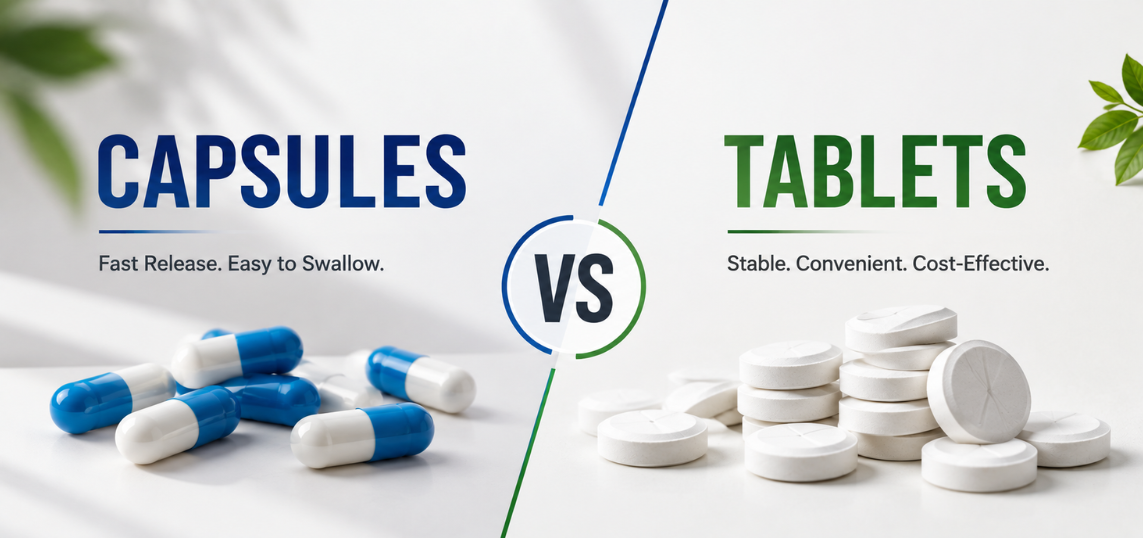
Capsules are dosage forms in which active ingredients are enclosed within a shell, commonly made from gelatin or plant-based materials. They are often chosen for formulations that require faster dissolution or improved swallowing comfort.
Tablets, on the other hand, are manufactured by compressing powdered ingredients into a solid form. They are widely used because they are durable, cost-effective, and suitable for a broad range of pharmaceutical and nutraceutical products.
Both dosage forms are effective when developed and manufactured according to quality standards.
Key Differences Between Capsules and Tablets
Manufacturing
Tablets are generally easier to manufacture in large volumes, making them a cost-effective option for many products. Capsules involve additional filling and encapsulation processes, which can increase production complexity.
Consumer Experience
Many consumers find capsules easier to swallow because of their smooth outer shell. Tablets, however, are available in different sizes and coatings that can also improve ease of use.
Stability
Tablets often have a longer shelf life because they contain less moisture and are mechanically more stable. Capsules may require more careful storage depending on the formulation.
Cost
From a manufacturing perspective, tablets are typically more economical, while capsules may involve higher production costs due to specialized materials and processing.
What Do Consumers Prefer?
Consumer preference varies depending on several factors rather than one dosage form being universally better than the other.
Many consumers prefer capsules because they:
- Are often easier to swallow.
- May have less noticeable taste or odor.
- Are commonly associated with premium wellness products.
Others prefer tablets because they:
- Are familiar and widely available.
- Often cost less.
- Are available in a variety of formulations, including chewable and scored tablets.
Ultimately, the preferred dosage form depends on the target audience, product category, convenience, and personal preference.
Business Considerations When Choosing a Dosage Form
When selecting a dosage form, businesses should evaluate more than consumer preference.
Important considerations include:
Product Formulation
Some active ingredients are better suited to capsules, while others perform well in tablet formulations.
Target Market
Understanding customer expectations can help businesses select a dosage form that aligns with market demand.
Manufacturing Capability
Production capacity, equipment, and formulation requirements should be considered before finalizing the dosage form.
Cost Efficiency
Businesses should balance production costs with product positioning and pricing strategy.
Packaging and Distribution
Storage conditions, transportation, and packaging requirements can vary between capsules and tablets, influencing overall operational efficiency.
Capsules vs Tablets: A Quick Comparison
| Feature | Capsules | Tablets |
|---|---|---|
| Ease of Swallowing | Often easier | Depends on size and coating |
| Manufacturing Cost | Generally higher | Generally lower |
| Shelf Life | Good | Often longer |
| Consumer Preference | Popular for convenience | Popular for affordability |
| Product Flexibility | Suitable for many formulations | Highly versatile |
How Agrosaf Pharmaceuticals Supports Healthcare Businesses
Agrosaf Pharmaceuticals offers a comprehensive portfolio of pharmaceutical, nutraceutical, Ayurvedic, and OTC products developed through trusted manufacturing partnerships.
By focusing on quality, innovation, and evolving market needs, Agrosaf helps healthcare businesses choose formulations that align with consumer expectations and business objectives.
Conclusion
Both capsules and tablets play an important role in today's pharmaceutical industry. Rather than asking which dosage form is better, businesses should consider which option best aligns with their product formulation, target audience, and market strategy.
Understanding consumer preferences alongside manufacturing and commercial considerations can help businesses make informed decisions and build products that meet evolving healthcare needs.
Frequently Asked Questions (FAQs)
1. Which is better, capsules or tablets?
Neither is universally better. The right choice depends on the product formulation, intended use, consumer preference, and business objectives.
2. Are capsules easier to swallow than tablets?
Many consumers find capsules easier to swallow due to their smooth outer shell, although individual preferences vary.
3. Why are tablets commonly used in pharmaceuticals?
Tablets are cost-effective to manufacture, have good stability, and are suitable for a wide range of formulations.
4. How should businesses choose between capsules and tablets?
Businesses should consider formulation requirements, target audience, manufacturing capabilities, cost, packaging, and market positioning before deciding on a dosage form.
5. Can both capsules and tablets deliver the same active ingredients?
Yes. In many cases, similar active ingredients can be formulated as either capsules or tablets, depending on the product's intended purpose and formulation requirements.
Conclusion / Notes
Both capsules and tablets offer unique advantages. The right dosage form depends on product formulation, target consumers, manufacturing considerations, and business objectives rather than one option being universally better.
0 Comments
Recent Posts